
Dousoukai (1993)
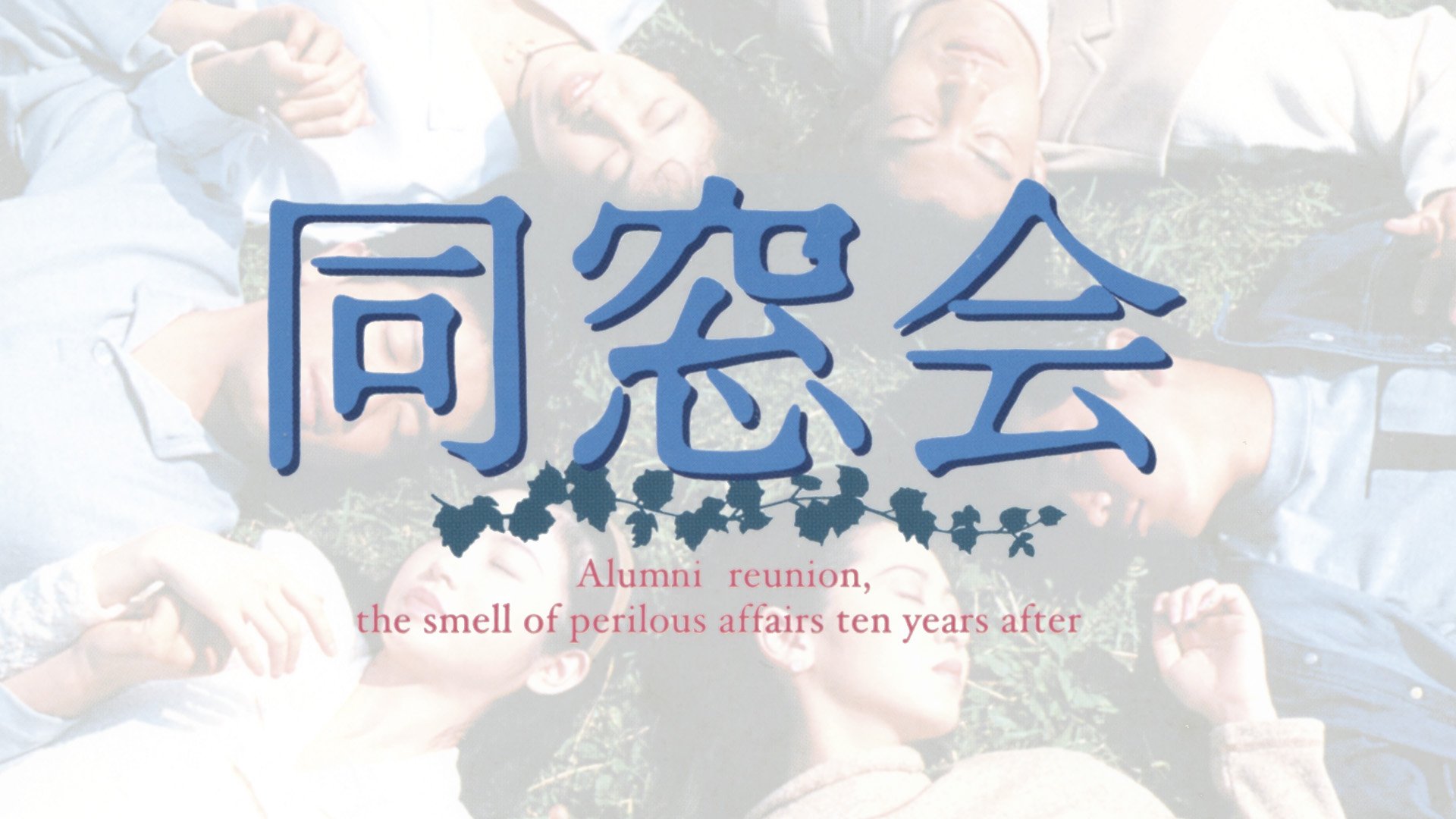
Dousoukai follows the story of three characters - Orihara Natsuki, Andou Fuuma and Atari Kousuke, all who studied at the same high school in rural Toi. Ten years later, with all three of them working in Tokyo, their lives take an unexpected turn with the introduction of Arashi, who as his name suggests, brings a storm of chaos into their lives.
Quick navigation
The most iconic 90s LGBT drama from Japan which had a huge impact on Japan and the content as we know it now. Just like previous Ossan's Love, it was a pillar of a certain time period. Granted, there were other dramas and movies in the 90s starring queer characters, but Dousoukai was a drama that did it on such a scale that no other drama from that period could ever compare.
It's said that the streets of Shinjuku 2-Choume (gay district in Tokyo) emptied out around the time this drama aired because everyone would be watching it from 10 to 11 pm.
I'll warn in advance that this drama contains a huge amount of nude scenes, sex scenes and later on some assault scenes, so please keep that in mind before starting it. But don't let that discourage you since this drama has lots of beautiful scenes and unique views on love to offer.
This has been years in the making, so I hope you enjoy the first ep!
You're free to choose which version you want - 480p is the original video, 1080p is the upscale for better readibility of subtitles, so I recommend that. The characters were color-coded in the past to keep track all of them even at a later time, so I've included that version as well. The colors have no particular meaning as they're random. The color-coded version has karaoke as well.
A massive thanks to furritsubs for even agreeing to work on this together with me. Together we could figure out most lines and it was hard work that spanned sooo many hours and replays. That said, if you know any Japanese people who can caption some difficult parts of the drama, feel free to let me know! Also, if you spot any errors and you know they're wrong with absolute certainty, I'd also appreciate you reaching out either privately or in the comments ^^
This project wouldn't have been possible without ksnykmm and their help in sharing non-corrupted raws. Thank you so much for rescuing this project.
Thanks to my friend for editing the custom made poster (from what it looks like).
There are special extras on the VHS release of this drama. If anyone owns it, I'd really appreciate it if you shared them with me for subbing!
Episode 1
Episode 2
I feel so sad that basically no one has shared their thoughts on episode 2 except my friends (not like ep 1 got any actual thoughts either), and even the people who reacted to episode 1 abandoned this drama. I've poured everything into this drama and dedicated countless hours over the span of 4+ years into subbing it. People would rather comment on YouTube and watch with awful auto-captions instead of giving me words of encouragement. Sadly, this is the kind of community we have right now with people used to getting instant AI subs and not appreciating actual human work. I spent most of my free time in July and August 2026 finalizing the subs for all the episodes, but at this rate I don't even feel like making them public. I've always made my subs free and available for everyone, but I don't even get any comments or thanks lately. Is there any point to sharing then? Best to just share with friends only. I'm grateful that episode 1 has over 1800 views on Dailymotion, but if only a small percentage of those views commented and showed their appreciation, I'd actually be motivated. I know it's been a year since episode 1, but still... (you can thank the reuploaders for that) I never wanted to abandon this drama and back when I started it, people actually looked forward to it. I know most people won't start this drama without it being complete, but I have feelings, too. I barely get any input on the stuff I sub, so I might as well just delete everything. I'm grateful for all watchers, but I'd rather have 18 watchers sharing their thoughts than 1800 silent watchers. I want my projects to touch people's hearts and for them to remember them even after a long time. I wish people cared more about things, but sadly this is the reality we live in where people expect things for free and I don't even get anything back for all my time spent working on all my projects. There's a real person working on all of them, even if it may not seem that way to you when you press play. This drama talks a lot about human connections, but I don't feel connected to anyone watching it. I wish people talked like they used to and shared everything it made them feel. It may be idealistic of me, but I'd still like people to interact more, especially now in this empty online age.
Translation notes
Episode 1
00:45 - The iconic scene of Natsuki scratching her crotch was recreated again in a 2007 MBS/TBS drama お・ばんざい!.
03:12 - He meant the words having atari in them and here it's all words with the kanji 当, but not the same kanji as in Atari's name which is 中 (he uses the naka kanji).
magureatari (紛れ当) - lucky shot
baatari (場当たり) - ad hoc, playing to the gallery, spur-of-the-moment
yatsuatari (八つ当たり) - venting anger
03:22 - "Since June, the interest rates have been liberalized, so do consider transferring from your regular savings account from now on."
Hope this one makes sense banking-wise because economics isn't my strong suit. 1993 was a year of huge financial reform in Japan, you can find out more about it with this scientific article
08:27 - "People from Matsuki Bussan are here to proceed with the formalities." this line was kept vague on purpose because I don't know what they meant banking-wise
09:20 - A lot of the drama is situated in Toi located on the Western side of Izu Peninsula. Toi is known for its onsen, nature, gold mining and beautiful early cherry blossoms. Here it is on google maps.
17:11 - Chose to omit the fishing section with Katsushige because it's nothing important. Just fishing talk and I wasn't sure about some lines, so I thought it's best to skip it since it overlaps with the music anyway. If anyone knows all the lines spoken, do let me know.
17:57 - "I mean, when they'd be awarding the participation awards, they'd say it's only for those who finished, even though I registered when they first announced it."
I think that's what she meant when she mentioned the participation awards, but not fully sure because of one word.
24:07 - I guess Hige not releasing his pheromones when surrounded by old men and women is a reaction to Shidehara's line of him being blunt, but how that's related still eludes me.
35:02 - "Around the time when the Showa era ended and Heisei era started." - They meant end of year 1992 / start of 1993, forgot to add it.
43:23 - "This summer, the LDP government collapsed, and Hosokawa's new cabinet was born."
LDP (Liberal Democratic Party) is a nationalist and conversative party that has been in power almost continuously ever since 1955 (its establishment). However, 1993 was a year they didn't manage to hold onto the majority and lost in the general election.
From wikipedia:
"The LDP managed to hold on to power in 1990 Japanese general election despite some losses. In June 1993, 10 members of the party's liberal-conservative faction split to form the New Party Sakigake. The end of the postwar miracle economy, the Japanese asset price bubble and other reasons such as the recruit scandal led to the LDP losing its majority in 1993 Japanese general election held in July of that year.
Seven opposition parties – including several formed by LDP dissidents – formed the Hosokawa government headed by Japan New Party leader and LDP dissident Morihiro Hosokawa, who became the Prime Minister preceded by Kiichi Miyazawa. However, the LDP was still far and away the largest party in the House of Representatives, with well over 200 seats; no other individual party crossed the 80-seat mark. Yohei Kono became the president of the LDP preceded by Kiichi Miyazawa, he was the first non-prime minister LDP leader as the leader of the opposition."
Episode 2
00:59 To protect ourselves against thieves, so no intruders can get in.
In Japanese, there's a word "dorobou neko", lit. thieving cat, which is used for boyfriend/husband snatchers.
10:25
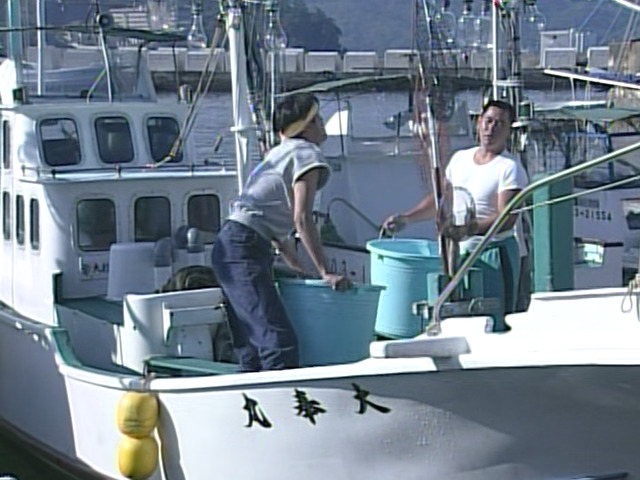
The fishing boat "Taihoumaru" is actually still available for rental! Here's the official website.
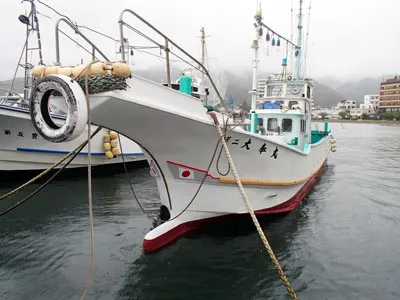
This is the second Taihoumaru. It's quite similar to the first one as you can see. You'd most likely find it docking in the Toi Port if you visited!
This is the first Taihoumaru from the drama:
18:28
They're talking about kanreki (還暦) here which is your 60th birthday (or 61st birthday if you go by the kazoedoshi system in which you are born as a 1-year-old). Kanreki is connected to your Chinese zodiac, and it represents the end of a full cycle, and a return to your birth (a rebirth of some kind). It takes about 60 years to fully cycle to your birth zodiac and its element going through all the possible combinations (12 zodiac animals and 5 elements).
19:52
As mentioned in the subs, they were born in the Fire Horse Year (hinoe-uma 丙午), and there's a very common superstition associated with it. It's said that women born with the Fire Horse zodiac are strong-willed, energetic and decisive. They are said to bring ruin to their families and husbands (even be fatal to their husbands). Japanese couples would go as far as avoid birthing children in this year (either through planned contraception or through abortions). The superstition hides a dark past that I won't go into, but 1966 actually saw a decrease of 25% of births from the previous year.
But why am I mentioning it again? Because 2026 is a Fire Horse Year which started in February! It's kinda a fate I'm releasing this episode this year, isn't it? So this means most of the class was born in 1966, with Chino being born shortly after in 1967, most likely in February or in March. So age-wise they are 27 or 26.
This makes me wonder how many births we'll see from Japan this year. In an already declining population, the birth rate might stagnate even further. I haven't seen the statistics for this year yet, but I'll definitely check it out at the end of the year.
If you'd like to know more about the legend that birthed the supersitition, I recommend this article.
25:17
There are three dramas namedropped here: "Dare ni mo ienai", "Wataru Seken wa Oni Bakari", and "Akuma no Kiss". It's quite unusual for a network to namedrop other network's drama these days (you almost never see it), but there's a reason why these two were namedropped.
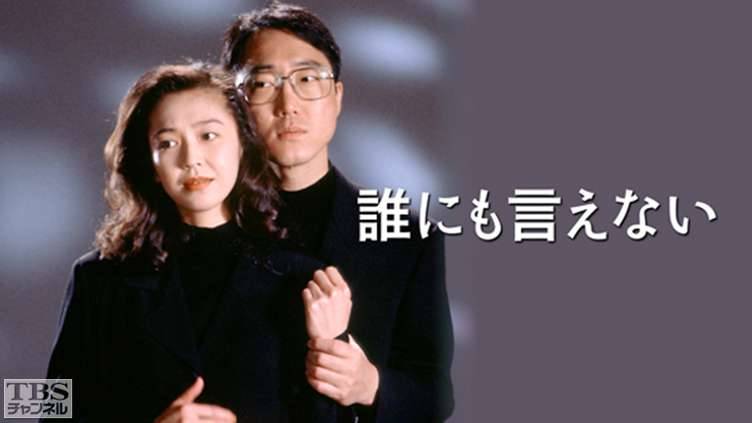
Dare ni mo ienai was another shock factor drama that was popular in 1993 depicting an intense obsession.
Wataru Seken wa Oni Bakari is a long-running TBS series spanning 1990 all the way to the present. In the drama, they are referencing the second series which ran from April 1993 to March 1994. Its popularity was quite high as well.
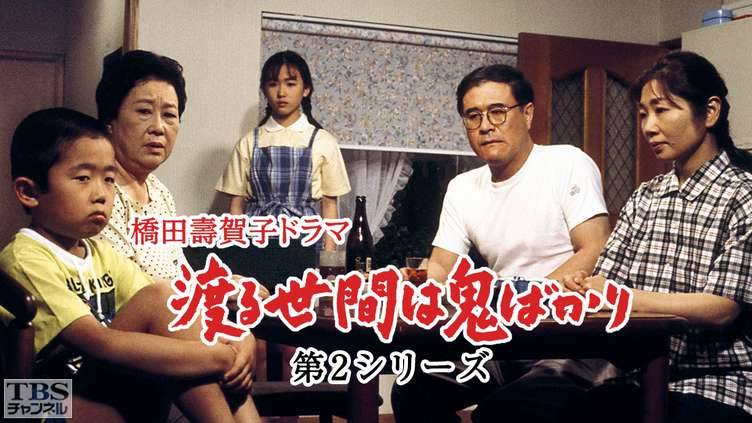
Recently, a drama with an AI script trained on the scripts of the previous instances has been broadcast... I think it's a disgrace, but you do you, TBS... Not expecting good things from you.
The third drama is Akuma no Kiss, a Fuji TV drama. This was another shocking 18+ drama that aired around the same time starring a lesbian character.
29:55
A game of chicken (チキンレース) is a competition of who's braver. Even though it's literally a "chicken race", it can be used for anything, not just races.
36:30
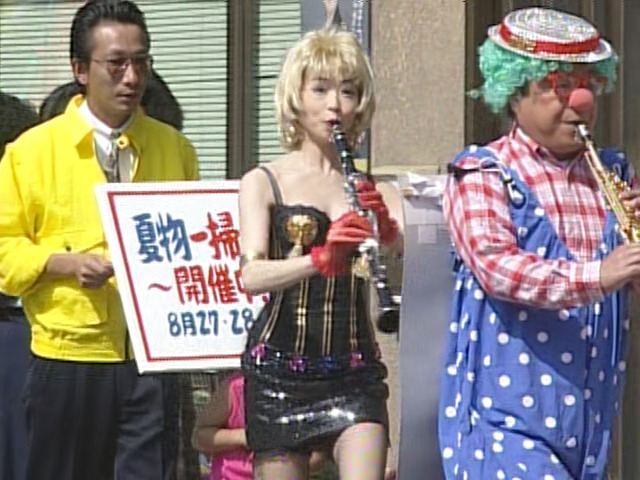
Here you see chindon-ya! A group of traditional street performers dressed in eccentric wear. They are a rare sight because they have more or less disappeared now.
37:28
Chino asks if she can order something with "saisho" (or I'm completely mishearing). I have no idea what this is and I already searched everything. I even searched for local specialties with ice cream and I still have no idea. Anyone has any idea? Then she orders two of those.
41:34
Here Shidehara is reading a passage from Oku no Hosomichi (The Narrow Road to the Interior), a famous work by the poet Matsuo Bashou.
"hyakudai" (百代 - often translated as eternity, literally hundred generations) here is read as "hakutai", and it's a common mistake students make.
You might think this is random, but nothing about the script of this drama is random (if only we had the script...). There was thought put to everything. Matsuo Bashou was a poet who was fascinated with homosexual love, and is said to have had several of his disciples as his lovers.
The title itself could very well be a reference to anal sex (oku is the word for going in deep, and hosomichi is a narrow path).
42:27
Fuuma uses kimchi here in place of cheese or smile because that's how they do it in Korea.
42:36
Yoga is a part of Setagaya Ward, Tokyo.
Comments